
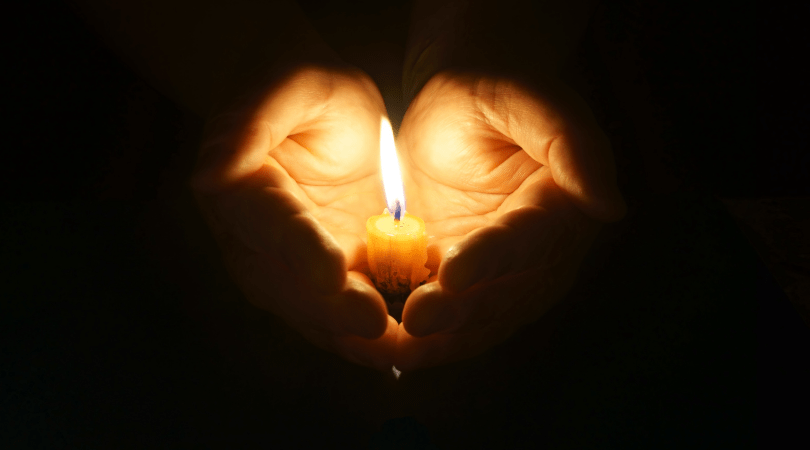
Any jedi will tell you that fear leads to the Dark Side. And yet we all experience fear as a consequence of being human; each of us has a dark side. What’s over there anyway? What lurks in the shadows? And to that point, why do we assume that it’s “lurking”? Perhaps whatever is there in the dark is only waiting, gently and patiently, to be discovered? After all, to be afraid is to acknowledge that we have something to lose- something precious, treasured, and immensely important. As Neil Gaiman, author of many a deliciously dark tale, puts it, “We have been telling each other tales of otherness, of life beyond the grave, for a long time; stories that prickle the flesh and make the shadows deeper and, most important, remind us that we live, and that there is something special, something unique and remarkable about the state of being alive.” As we head into the spooky mists of October I’d like to peer into the darkness, peek behind the veil, and take a closer look at the experience of fear in the bodymind.
I got an urgent text from my husband the other day, “Please come outside NOW!!!”. As I made my way onto the patio I wondered what could be so epic as to require three exclamation marks, and so paralyzing that he couldn’t just open the door and come get me from inside. I arrived to find him pointing down into the garden at….nothing. “It’s a snake”, he said, “what are you going to do?” I did finally find the widdle snek. It looked like an earthworm with a face. And it was terrifying for him, triggering a rush of epinephrine, norepinephrine, and a spooktakular cocktail of dozens of other hormones. No shame, my love, a recent gallop poll found that 56% of the population would have reacted the exact some way.
“Nothing in life is to be feared, it is only to be understood. Now is the time to understand more, so that we may fear less.”
― Marie Curie
We don’t consciously choose to go into fight, flight or freeze mode. It’s a survival instinct that is hard wired to kick in when we are threatened, and to summon super strength to fight the threat, super speed to book it right on outta there, or super stealth to evade it. When these neurochemicals flood the bloodstream the heartrate and blood pressure increase, pupils dilate, blood flow is diverted from the skin to the major muscle groups (that’s why we get “the chills”), and non-essential systems, like immunity and digestion, get shut down in order to give the body more energy to throw down. While all this is happening, and usually without our even realizing it, the brain is also in high gear processing the signals it is receiving from the senses, comparing them to similar signals it has experienced in the past, and assessing whether or not we are in deep shitake. In the course of our evolution, the person who almost stepped on a water moccasin was able to call up the reflexes and speed to leap to safety and survive, passing that fear on to the next generation, and eventually to my husband and 56% of the world. Charles Darwin was fascinated by our evolved response to fear. He designed a little self-experiment with a puff adder at the London Zoological Gardens. He stood as close to the glass as possible and noted that every time it moved towards him, he felt his face grimace and involuntarily jerked back from the glass, “My will and reason were powerless against the imagination of a danger which had never been experienced.” He found that the fear response is an ancient instinct that cannot be undone even by the kooshiness of our modern civilization.
So why do we seek out the dark side? Why do we do “shadow work”? Why is the horror genre a multi-million-dollar industry? Some suggest that the fear response mimics arousal, and that we are essentially getting off on getting scared. And while that is probably a little bit true, I think there is more going on here. Wes Craven, king of the slasher flick, famously said, “Horror movies don’t create fear, they release it”. And in her article for Yoga Journal, Sally Kempton says:
“The truth is that fear doesn’t have to be paralyzing: For a person on the verge of transformation, fear can be a great teacher.”
In the yogic tradition we have Abhinivesha, or “fear of death”. It is one of the Kleshas, or causes of suffering, that fall under the umbrella of Avidya, or “wrong seeing”. We understand Avidya as a sort of film over the eyes that prevents us from seeing and experiencing things as they truly are. In my husband’s case, Avidya is why he, an extremely strong and handsome and brilliant man (please don’t be mad at me for writing about you) perceived a baby garter snake as a valid threat. Avidya is why I have, in the past (certainly in middle school, but possibly even more recently than that), blamed another person for being judgy and making me miserable, when in fact, it was my own judgement of myself and others that was causing my suffering. In our practice we shine a light into the dark places to watch our own thoughts and emotions.
When we wobble in a balance pose and feel our thoughts wander to who might have seen it, and what they might think, we try to observe that thinking habit, gently and tenderly. If we catch ourselves in negative judgement of ourselves, we mindfully bring the attention back to the breath, and reconnect to our Source of unconditional acceptance and love. The practice is an effort to turn off auto-pilot, including the fight, flight, or freeze response; to mitigate the suffering that results from low vibrational thoughts and feelings. Yoga walks us into the dark side to explore the shadow, the unknown self, and teaches us that through a process of self-study we can come to know that part of the Self that cannot die. In the Bhagavad Gita, Krishna describes the Self this way, “Swords cannot pierce it, fire cannot burn it, water cannot wet it, and wind cannot dry it”. The practice would have us understand our truest and most authentic Self- whole and righteous, perfect and eternal.
And so I offer you the advice of C. Joybell C. “Don’t be afraid of your fears. They’re not there to scare you. They’re there to let you know that something is worth it.” Beautiful words indeed. But if, under the full moon on Halloween night, you see a puff adder or a clown with a balloon or something you should probably still dig out.

Emily is a yogi, professional voice actor and singer, and a mother to two strong little women. She has experienced, first hand, the physical, mental, and emotional benefits of the practice of yoga, which is why she is so passionate about guiding other seekers along their way. Emily creates a safe space for each student to learn about and explore the poses, offering guidance to connect them to their own inner teacher. Emily loves creating dynamic sequencing and playlists, and will often sing students into or out of Savasana. She is an RYT200 graduate of Driftwood Yoga and Aerial, and you can find her here in the studio Tuesday, Thursday, and Friday mornings
 FCYP blog